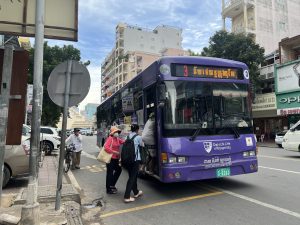
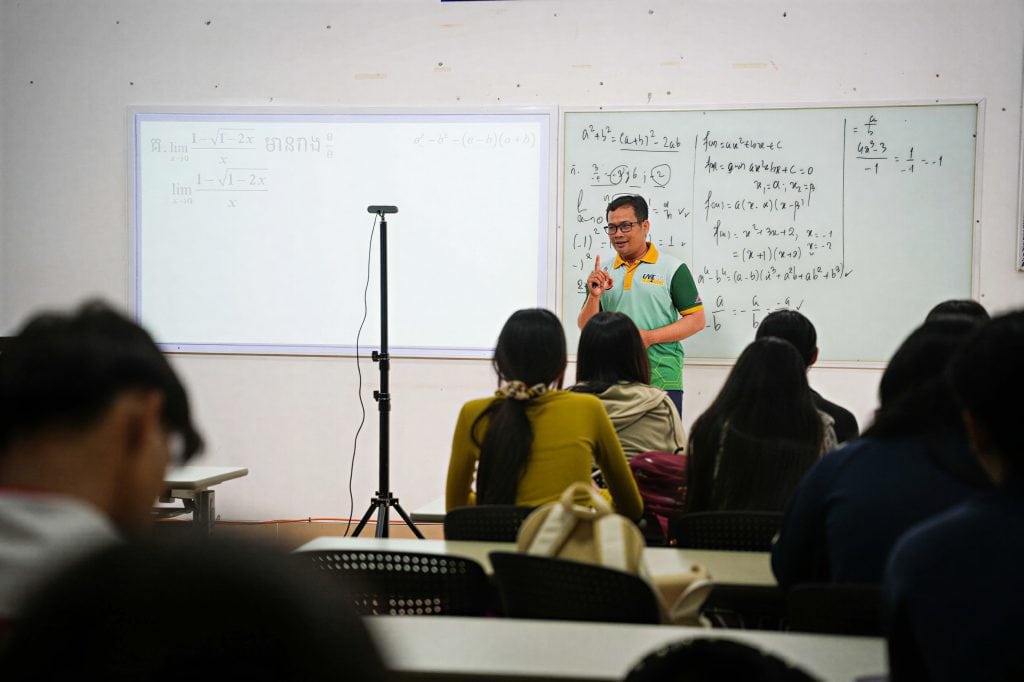
Students attend Live Teaching weekend class at Indra Devi High School in Phnom Penh on 26 April 2026. Photo by Sokhun Bondet
By Sam Darafy and Soeurn Sieng
PHNOM PENH – Sundays have taken on an entirely new rhythm for 19-year-old Chan Dara. With a notebook propped open, the Angkor Borey High School senior eagerly waits for her virtual lesson to begin.
Just a few months ago, Dara’s Sundays meant slow mornings scrolling through her phone and occasional outings with friends. Today, her weekends revolve around a livestreamed broadcast from the Ministry of Education, Youth and Sport’s ‘Live Teaching’ program. For Dara, the weekend is no longer just a break, but a vital opportunity to prepare for the upcoming national high school exam slated for August 10.
“For me personally, it’s a really great habit,” Dara said. “Usually, after I woke up, washed my face, and took a bath, I would just sit and play on my phone or go out. Now, I’ve switched to sitting and studying at home instead. We get to stay home, and we get knowledge at the same time.”
Dara is one of thousands of students across Cambodia turning their weekends into extra study sessions. Launched to level the playing field, the Live Teaching program provides free supplementary weekend lessons through digital platforms, making exam preparation accessible to students regardless of their financial background or geographic location.
From Solo Scrolling to Collaborative Classrooms
While Dara logs on from home, other students experience the program through physical classrooms. Teu Vanna Lyly, a Grade 12 student at a private school in Phnom Penh, discovered the program through weekend sessions hosted at Indradevi High School.
Before joining, Lyly’s weekends were largely unstructured. “Previously, I was free and didn’t do much. I mostly stayed home and slept,” she said, noting that her free time was typically spent playing video games or browsing social media.
The program quickly transformed her routine. Lyly now wakes up early to review her morning lessons, finding that the structured classroom environment keeps her engaged far better than independent study.
“When I studied alone at home, I often lost focus after one or two hours,” Lyly admitted. By contrast, the classes at Indradevi High School are highly collaborative, featuring group discussions on formulas, interactive problem-solving, and practice sessions with past exam papers.
Hong Sim, a physics teacher at Indradevi High School, is thrilled by this dual approach. He noted that the program allows him to deliver tailored lessons that meet students’ diverse needs, whether they are sitting in his classroom or streaming from afar.
“I am delighted to see many students learning in both physical classes and online classes,” Mr. Sim said.
Lightening the Financial Burden
In Kampong Chhnang Province, 18-year-old Lanh Somey uses the program’s digital resources to supplement her education independently. Every Sunday, the Hun Sen Baribor High School senior logs into the program’s Telegram group to download practice exercises for mathematics, physics, and chemistry, later turning to YouTube to review recorded lessons on challenging topics.
For Somey, the free platform has provided significant financial relief. Before discovering the program, she spent roughly 120,000 riel per month on private tutoring. While she still attends some extra classes, Live Teaching offers high-quality, cost-free instruction from experienced educators.
Further northwest, Noy Ratana, a senior at Hun Sen Oddar Meanchey High School, experiences the program through yet another format: group viewing. Instead of studying alone, he and his classmates gather in their school classroom to watch the live lessons together on a smart TV.
“Studying in class is very convenient,” Ratana said. “We just come to school and study. The teacher mostly uses a Smart TV to display the lesson, and the picture and sound are very clear.”
Ratana prefers this modern approach, noting that the digital presentation slides allow teachers to explain concepts quickly without wasting time writing on the blackboard, leaving more room for peer discussion.
This hybrid model has also reshaped the financial dynamic for Ratana’s family. His mother, Hout Kimhour, noted that the free program dramatically slashed their household education expenses.
“Before joining this program, I used to pay 150 000 riels for five extra classes for Ratana [every month],” she said. “Now, I only have to pay for two subjects, mathematics and Khmer, which cost 60 000 riels. He studies Chemistry, Physics, and Biology through the Live Teaching program.”

Students attend a Live Teaching weekend class at Anlong Veng High School in Odor Mean Chey Province on 24 May 2026. Photo by Sreng Koma
Bridging the Educational Divide
The Live Teaching Supplementary Program was officially launched on May 10, 2026, at Indradevi High School by Dr. Hang Chuon Naron, Deputy Prime Minister and Minister of Education, Youth and Sport. Modeled after the New Generation Schools framework, the initiative is coordinated by the Center for Digital Distance Education.
Program Coordinator Cheat Chancharonai explained that the program aims to address critical teacher shortages in remote provinces—particularly in advanced mathematics, chemistry, and physics. Looking ahead, the ministry plans to expand its network from 78 partner schools to remote areas nationwide over the next five to ten years.
“Our goal is to ensure that every student, no matter where they live, has the opportunity to learn from qualified teachers through technology,” Chancharonai said.
The tangible impact of this digital push is already evident. At Anlong Veng High School in Oddar Meanchey province, the high school passing rate stood at 87 percent in 2024 before the school joined the program. According to teacher Sreng Koma, that number climbed to 90 percent in 2025 after the system was implemented.
Beyond the statistics, Mr. Koma is most proud of the cultural shift he sees each weekend.
“Before joining this program, on Saturdays and Sundays I would often see our students gathering at local coffee shops just to play mobile games,” Mr. Koma observed. “But now, that has completely changed. They come to school on weekends and sit down to learn together.”
From the quiet homes of Takeo to the collaborative classrooms of Phnom Penh and Oddar Meanchey, the Live Teaching program is redefining the Cambodian students’ weekend—turning idle free time into a collective, tech-driven drive toward academic success.
—END—
Note on AI use: This feature was reported and written by Sam Darafy and Soeurn Sieng, students in the ‘News Reporting and Writing II’ course, and edited by lecturer Ker Munthit. ChatGPT, free version, was used at the final editing stage to assist with language, grammar, structure and readability. AI was not used to generate reporting, facts, quotes or analysis. The edited text was fact-checked by the lecturer and approved by the authors before publication.