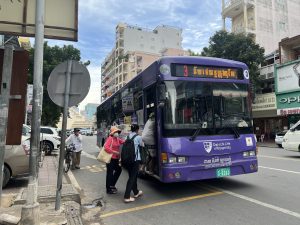
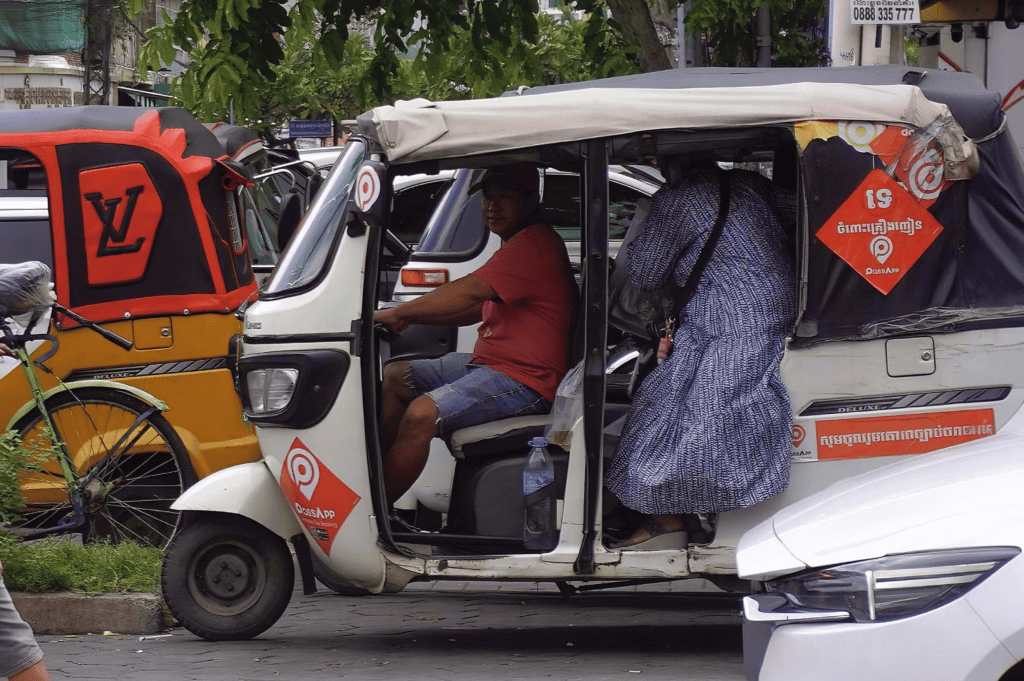
A rickshaw driver waits as a passenger climbs into the vehicle on the side of the road, August 8, 2026.
Photo by Or Vipheavy
By Or Vipheavy and Re Yunchhay
PHNOM PENH — Every day before sunrise, 42-year-old Sat Vanty leaves his rented room in the city to start a shift that rarely ends before 11 p.m. Originally from Koh Thom district, Kandal province, Vanty has navigated Phnom Penh’s crowded streets behind the wheel of an auto-rickshaw since 2017 to support his wife and two children.
“I leave home at 4:00 AM all the way until 11:00 PM when I return,” he said. “In a day, it’s no less than 13 to 14 hours. Take a shower, change clothes real quick—if I dared to get a full night’s sleep, we’d starve.”
Vanty’s grueling daily routine reflects a stark reality facing thousands of transport workers across Cambodia’s capital. Once a reliable route to a sustainable income, auto-rickshaw driving is now facing a growing uncertainty. Drivers are being squeezed simultaneously by high global fuel prices, a crowded market, and shifting commuter habits.
Fuel costs present an ongoing financial threat. Driven by the Middle East conflicts, liquefied petroleum gas (LPG)—the primary fuel for auto-rickshaws—has fluctuated wildly. Previously costing 1,900 to 2,000 riels (US$0.50) per liter, prices surged to 5,000 riels (US$1.25) or higher during peak spikes, particularly in April. When prices hit those highs, Vanty was forced to park his vehicle and return home to do farm labor for nearly two months because driving meant losing money.
“When fuel prices kept rising to 5,000 riels, I just couldn’t handle it anymore,” Vanty recalled. “From morning till evening, I made 50,000 to 60,000 riels (US$12.50–US$15), but filling up cost 55,000 riels. I was losing income.”
Although LPG prices have recently settled around 2,500 to 2,600 riels per liter, high operating expenses continue to erode margins.
The math is similarly bleak for 46-year-old Sok Rous, who has driven in Phnom Penh for nearly two decades. Operating around the city’s outskirts where passengers are spread far apart, longer trips no longer guarantee profits due to fuel costs.
“With fewer passengers and too many drivers, I barely make five dollars a day,” he said. “I used to earn at least ten dollars a day.”
Exiting the trade is rarely an option. “I’ve thought of switching careers, but I am old and lack skills,” Sok Rous added. “With little education and physical illness, it’s incredibly difficult.”
Compounding fuel pressures is a fundamental shift in how Cambodians move.
The vast majority of the city’s residents own motorbikes or cars. And when they don’t drive them and need to use transport services to go somewhere, many prefer app-based electric vehicle (EV) platforms or private ride-hailing services over traditional rickshaws.
“The rise of EV cars is heavy competition for us,” said Vanna, a 59-year-old driver who declined to give his last name.
Before sunrise, Vanna loads fresh vegetables onto his auto-rickshaw to deliver to his wife’s market stall in the Chamkarmon district. Once the morning rush dies down, he make his way through Phnom Penh’s congested streets in search of passengers. But he faces tougher competition each day. “People choose EV services because they are more comfortable and cheaper,” he said.
Financial commitments complicate matters further.
To own his US$3,830 rickshaw, Vanty – who is from Koh Thom district, Kandal province – put down a US$1,500 down payment and pays US$100 monthly in installments, on top of US$50 for rent and utilities. Each week, he attempts to send 150,000 to 200,000 riels (US$37.50–US$50) home to his family, but it’s getting harder to make enough saving because of high oil prices.
Vanty notes that market saturation worsens the issue: “The tuk-tuk market is getting quite crowded. Everyone gets a little piece of the pie—a little for them, a little for us—so it doesn’t add up to anything substantial. The market is very tight.”
To keep up with daily necessities, drivers like Dang have pushed their working hours late into the night. “Before the price hike, I only worked until around 5 p.m.,” Dang said. “Now I need to extend my work until night just to keep up.”
These long hours highlight the acute vulnerability of informal sector workers.

An auto-rickshaw driver picks up passengers at a bustling market in Phnom Penh, August 8, 2026.
Photo by Re Yunchhay
Vorn Pov, president of IDEA – Cambodia’s biggest association of informal economy workers – emphasized that auto-rickshaw drivers shoulder market shocks without safety nets.
“They spend more than they earn,” Mr. Pov explained. “Some 30 percent of them are homeless, sleeping on their rickshaws behind the Royal Palace, in Boeung Kak, and at Chroy Changvar Bridge due to not being able to afford utility and rent fees.”
Pov noted that without insurance or formal contracts, taking a day off for illness or rest means missing meals at home. He advocated for targeted relief, including fuel subsidies, micro-support programs, and accessible health checkups to ease the burden on small-scale drivers.
Without policy interventions, drivers rely strictly on resilience.
“I just wish for our country to have peace,” Vanty said. “When things are stable and market goods become cheaper, we might actually have some leftover money from what we earn.”
As night falls over Phnom Penh, auto-rickshaw drivers continue their search for passengers to pick up. For drivers like Vanty, Vanna, Sok Rous, and Dang, every trip carries the continuous challenge of rising costs, heavy competition, and the necessity of sustaining their families.
#informaleconomy #rickshawdrivers
–END—
Note on AI use: This feature was reported and written by Or Vipheavy and Re Yunchhay, students in the ‘News Reporting and Writing II’ course, and edited by lecturer Ker Munthit. Gemini, free version, was used at the final editing stage to assist with language, grammar, structure and readability. AI was not used to generate reporting, facts, quotes or analysis. The edited text was fact-checked by the lecturer and approved by the authors before publication.