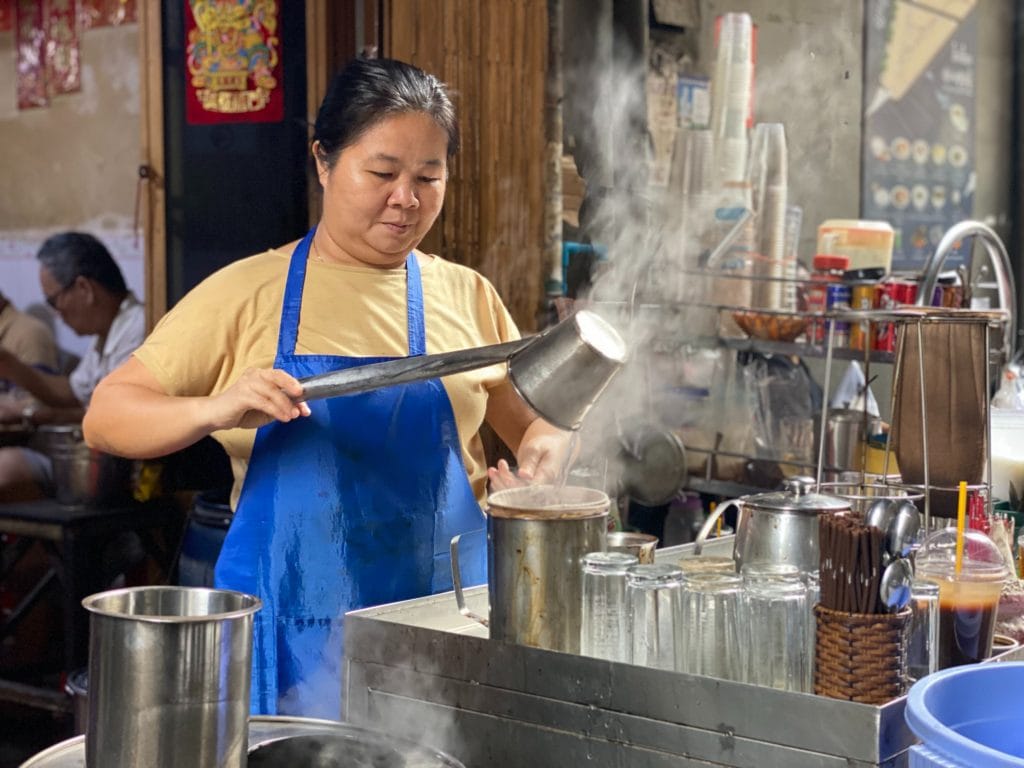
Srey Mouy prepares coffee for customers at her Three Generations Coffee Shop in an alleyway near Orussey market.
Photo by Khoem Sreypov
How a hidden neighborhood spot became the go-to gathering place for locals and morning caffeine seekers.
By Krouk Dalin and Khoem Sreypov
PHNOM PENH – Long before dawn breaks over Phnom Penh, while most of the capital is still shrouded in silence, a small alleyway near Orussey Market is already humming with life.
The sharp clink of metal spoons against glass cups breaks the early morning calm. Ms. Srey Mouy, the owner of Three Generations Coffee Shop, moves smoothly through her familiar routine.
“I start preparing everything at 4:00 AM,” she says. “Even while I’m setting up, regular customers are already waiting outside. Coming here has simply become their morning ritual.”
Tucked into a narrow alleyway in one of the city’s busiest commercial districts, Srey Mouy’s shop is far more than a place to grab a morning caffeine fix. It is a neighborhood rendezvous kept alive by loyal regulars—a place where local stories are swapped, intergenerational bonds are tested and strengthened, and a vanishing piece of Cambodian street culture is preserved daily.
The Morning Ritual
By daybreak, the shop’s knee-high vintage tables are fully occupied, predominantly by elderly men waiting for their brew. Each order arrives with a traditional glass of hot coffee accompanied by tae p’kap—hot tea served in an inverted glass set on a saucer to trap the heat. Here, no one sits in isolation for long. Conversations spark naturally over morning headlines, family life, and city news.
“I’ve been coming here almost every morning for over ten years,” says 69-year-old Mr. Sokha. “To me, everyone at the tables is a friend. We share stories and enjoy time together, and it has now become part of my daily routine.”
The Afternoon Shift
As midday approaches, the energy of the alley subtly shifts. Women join the gathering after wrapping up household chores or returning from their shopping trips through the nearby Orussey Market.
While the afternoon atmosphere is slightly quieter, the communal spirit remains unchanged. At one table, a group of grandmothers chat about family updates and local gossip. Nearby, a quiet game of cards unfolds. Across the narrow alley, men in their 50s debate everything from the cost of fuel for tuk-tuk drivers to international sports and political news. In the corner, an old man reads a newspaper spread wide across his table, his hot coffee steaming beside him.
Conversations flow freely across tables. Neighbors call out to each other by name, pull up spare plastic chairs unprompted, and readily pull passersby into the chatter.

A man brews coffee as customers wait inside the Three Generations Coffee Shop in an alleyway near Orussey market.
Photo by Khoem Sreypov
A Stark Contrast in a Digital Age
In a rapidly modernizing country fully embracing digital life, scenes like this are becoming increasingly rare. Just a few meters away stands a trendy, air-conditioned café outfitted with Wi-Fi, sleek interior decor, and modern espresso machines—tailored to younger professionals who sit quietly behind laptops and smartphones.
For the regulars at Three Generations Coffee shop, however, no modern café can replicate what Srey Mouy provides.
The biggest difference is human connection, explains 75-year-old Mr. Thorn, known locally as Grandpa Thorn. “Here, the owner and the customers know each other like family. Everyone talks freely without judgment, and even strangers become friends in minutes,” he said. “In modern cafés, people are often busy with their phones or laptops. But here, we spend time talking to each other like family and friends.”
Grandma Ni, 65, agrees: “Seeing people gather here every single day brings life to our whole alleyway. If this shop ever disappeared one day, it would feel like losing a piece of our community’s soul.”
A Micro-Economy Built on Mutual Support
The coffee shop’s survival is also tied to a delicate web of small neighborhood businesses that rely on one another. Srey Mouy sources her ice from a vendor down the alley, buys traditional snacks from the stall next door, and offers an affordable respite for weary market workers.
If the Three Generations Coffee Shop were to close, the ripple effect would be felt right across the block—a testament to the fragile economic ecosystem supporting Phnom Penh’s informal sector.
Facing an Uncertain Future
As Phnom Penh continues its relentless march toward modernization, local businesses like the Three Generations Coffee preserve something vital: an authentic sense of belonging that digital networks and modern amenities cannot replace.
Despite her steady stream of regulars, Srey Mouy is acutely aware of the threat posed by expanding café chains and shifting urban lifestyles.
“The biggest challenge for me is the growth of modern cafés,” she admits. “Even though our long-time customers keep coming back, the long-term future feels uncertain.”
Still, as the late afternoon shadows stretch across the old buildings, she has no intention of pulling down the shutters for good.
“As long as my customers keep coming, I will keep opening,” Srey Mouy said, wiping down a wooden table. “We don’t have air conditioning, fancy decorations, or Wi-Fi, but we have history. I just want this space to feel like home for everyone who walks in.”
_____________________________
Note on AI use: This feature was reported and written by Krouk Dalin and Khoem Sreypov, students in the ‘News Reporting and Writing II’ course, and edited by lecturer Ker Munthit. Gemini, free version, was used at the final editing stage to assist with language, grammar, structure and readability. AI was not used to generate reporting, facts, quotes or analysis. The edited text was fact-checked by the lecturer and approved by the authors before publication.