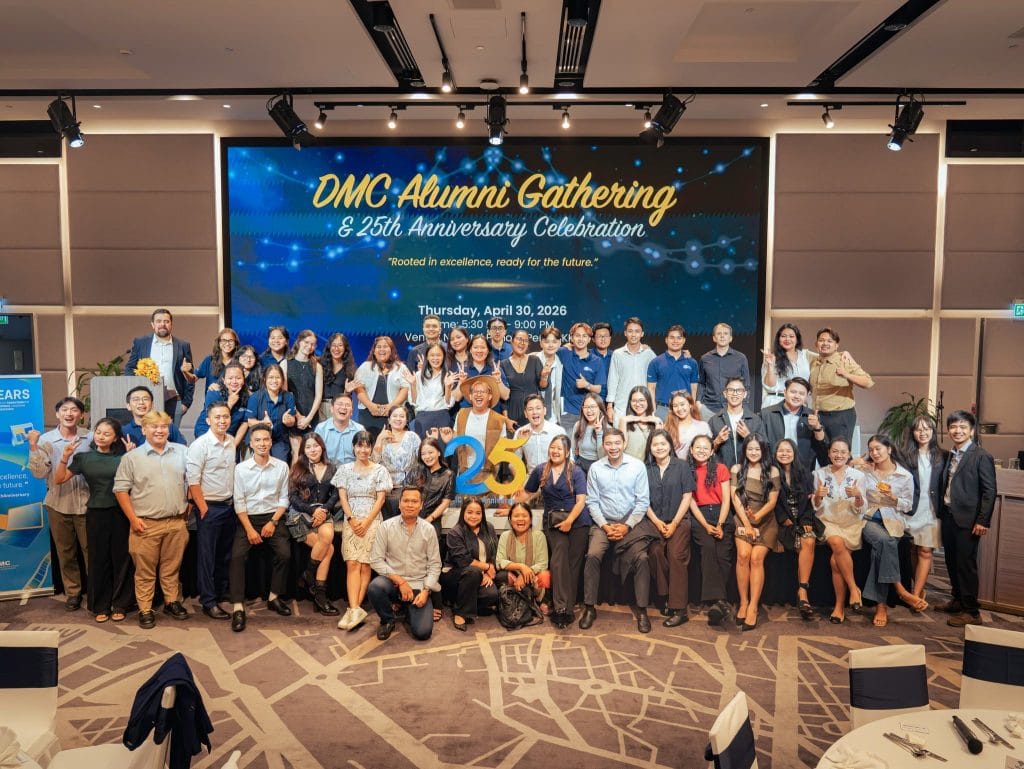
DMC alumni gathering for a group photo at the DMC Alumni Gathering and 25th Anniversary Celebration on April 30, 2026.
Photo by Chea Sokheng.
By Ny Chanvatey, Nan Menghor, and Khut Pisey
PHNOM PENH – The Department of Media and Communication (DMC) at the Royal University of Phnom Penh celebrated its 25th anniversary with a reunion spanning generations of students, alumni, lecturers, and staff.
What started as a formal milestone on April 30, 2026, quickly shifted to shared memories of tight deadlines, field reports, documentary shoots, and bond forged under pressure.
Since its founding in 2001, the DMC has helped train Cambodian journalists, communicators, and filmmakers. Yet returning alumni agreed on one point: DMC was always much more than a school.
Building a community
For Mao Vutha, a Batch 1 graduate now running a restaurant, the reunion brought back DMC’s formative days at RUPP. He recalled basic computer labs, early radio studios, and raw determination.
“My best memory is the intense Friday morning journalism quizzes with the late lecturer Reach Sambath,” he said.
With limited internet, training relied on direct reporting, tape recorders, and handwritten notes. “We couldn’t Google anything. We had to build real relationships with people,” Vutha said.
Sok Samphoasphalyka (Batch 9), now a consulting program manager, credited DMC with building her analytical eye.
“Reading the newspaper is one thing, but understanding the backstory and everything it took to get that story out was truly special,” she said. Guest lectures from organizations like the UN opened doors beyond newsrooms. “There were always networking opportunities during breaks, and I’ve maintained those connections ever since,” she added.
Small class sizes—just one cohort per batch—fostered tight-knit support.

Leng Len (Batch 10) recalled classmates quietly helping financially stretched peers afford field trips so no one was left behind.
“When I was a freshman, everyone knew everyone. Seniors always helped us,” Len said, remembering how assisting a senior earned her a first US$20 pay check, which she promptly spent on a magazine.
By her second year, Len interned at The Cambodia Daily, becoming only its second Cambodian reporter and securing a front-page story within two months.
“I believe journalism is about freedom of speech and being a voice for the public,” said Len, who is now an independent documentary filmmaker.

From Classrooms to Real-World Experience
As the media landscape evolved, DMC coursework pushed students far beyond the classroom. For Aun Chhengpor (Batch 13), print journalism was a defining course that taught students to write descriptively so readers could visualize scenes they hadn’t witnessed firsthand.
“Our instructors taught us how to write descriptively to make readers see the picture in their minds, even if they weren’t at the scene,” he said.

His most transformative moment came during Project 3, the department’s signature documentary assignment. His team tackled a Khmer Rouge topic, requiring extensive field research and interviews with a reluctant source.
“It was incredibly difficult,” Chhengpor said. “Even though we weren’t fully satisfied with the final cut, the learning curve was massive.”
That experience sharpened the reporting and storytelling skills that later propelled his career at The Cambodia Daily, Voice of America, and the Economist Intelligence Unit, leading to his current role as Director of Programmes at Future Forum.
Vevid (Batch 14) moved from Siem Reap and joined the 2014 cohort, also pointed to Project 3 as a turning point.
“We went to Siem Reap, faced many challenges, and that was the first time I learned video editing. That was the starting point of my video production journey,” Vevid said.

He echoed earlier generations in describing DMC’s tight-knit culture: “With only one class per batch, seniors and juniors were close. It felt like family.”
Though Vevid later transitioned into marketing and content creation, he credits DMC with instilling his core communication, leadership, and problem-solving skills.
“DMC became my second home,” he said.
A New Generation in a Changing Media Landscape
Later generations navigated a shifting DMC journey marked by digital transformation and pandemic disruptions. San Srey Nich (Batch 19), now a media manager, adapted to digital storytelling through two years of remote learning.
“Online classes felt like watching YouTube,” she said. “It was very different from being in the room with our lecturers.”
The disruption pushed her to explore video and podcasting. Connecting with alumni at the anniversary revived her initial graduation excitement: “Meeting seniors and having them recognize my content made me very happy. It felt like I’d just graduated again.”

Chhim Pich Boramey (Batch 21), a video reporter at Kiripost, balanced academics with newsroom demands by interning early to hone her production, filming, and editing skills.
“I learned much more than journalism,” Boramey said. “I learned how to handle pressure and collaborate effectively in real-world settings. My work now is ‘beyond writing’—I produce video content and interview experts across fields.”
A Shared Legacy Across Generations
From Batch 1 to Batch 21, DMC alumni consistently return to the same core values: resilience, curiosity, collaboration, and learning by doing. Across generations, they describe the department as a community defined less by its physical infrastructure and more by the relationships forged within it.
The department’s growth reflects this expanding footprint.
Ung Bun Y, Director of the DMC, noted that prior to 2018, the school admitted just one scholarship class of 30 students per year. Today, the department enrols up to four classes per cohort, totalling over 100 first-year students.
Later this year, the school will launch a master’s program in communication — “another remarkable milestone” in its 25-year history. The goal is to provide high-quality, affordable postgraduate education locally so students no longer need to study abroad.
This next move “reinforces our position as Cambodia’s premier academic institution for media, communication, and journalism, and reflects our commitment to transforming media education nationwide,” Mr. Bun Y said.