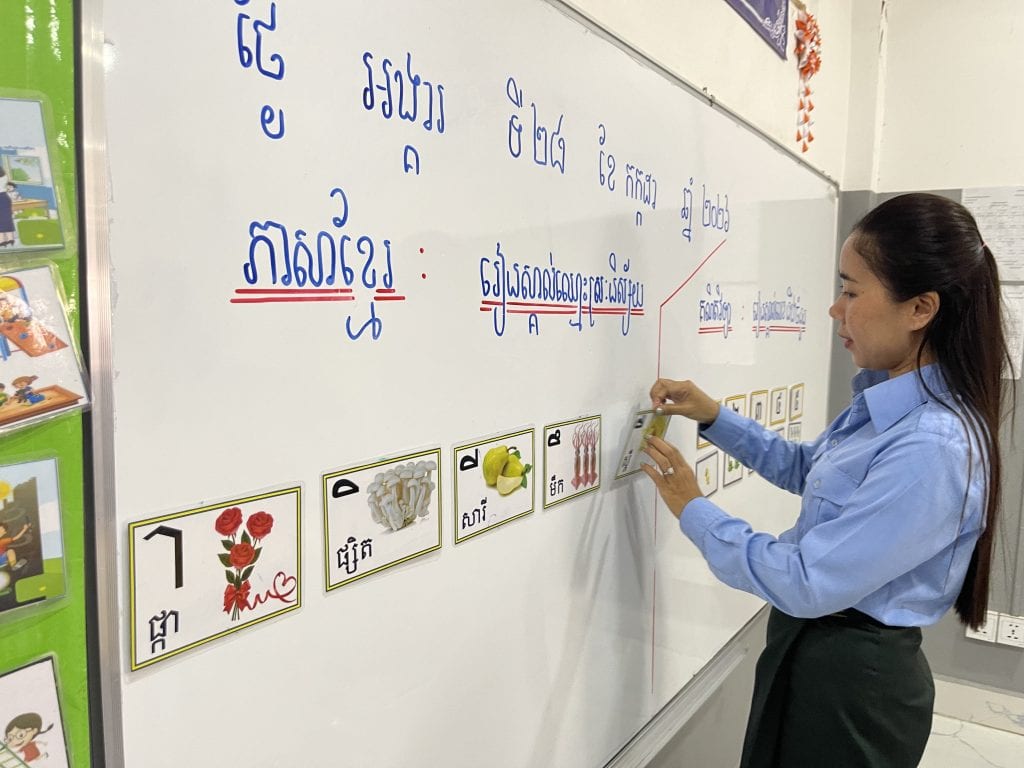
Pum Sreyphea teaches autistic students using picture cards on a whiteboard inside a classroom at The Rabbit School in Phnom Penh.
Photo by Noch Sreyleap
By Chheang Novomreasey and Noch Sreyleap
PHNOM PENH – Every morning, Pum Sreyphea prepares a classroom where no two children learn the same way. One student follows a schedule through picture cards. Another understands only simple one-word instructions. Some become anxious when routines change unexpectedly, while others communicate through gestures instead of speech. Progress is measured not by test scores but by quieter milestones—a child making eye contact, completing a task independently, or joining classmates in play for the first time.
For six years, Sreyphea, 29, has taught children with autism and other developmental disabilities at The Rabbit School in Phnom Penh, one of Cambodia’s few schools dedicated to children with special educational needs.
As awareness of autism and developmental disabilities grows across Cambodia, more families are seeking specialized education. Yet the number of schools, trained teachers and affordable services has failed to keep pace with demand. Long waiting lists, limited resources and uneven access—particularly outside Phnom Penh—leave many parents struggling to find a classroom where their children can learn.
Through the experiences of one teacher and one father, this story illustrates how Cambodia’s education system is striving to become more inclusive amidst growing demand for specialized education.
When Sreyphea joined The Rabbit School, she knew little about autism. A sociology graduate from the Royal University of Phnom Penh, she had always dreamed of becoming a teacher but never imagined she would build her career in special education.
“I want to help children improve because I think it’s not easy to find someone willing to teach them, as it is difficult,” she said in an interview.
Without a formal training in autism, Sreyphea learned through technical instructors, NGO workshops and exchange programs with overseas volunteers. Those experiences taught her that every child requires a different approach.
“Children learn in their own different ways,” she explained. “Some children can understand with just a single word of instruction, while others need to hear it many times. And some children need hands-on guidance; you have to hold their hands to show them how to do the action, or use pictures to teach them.”
Her classroom reflects that philosophy. Two teachers work with up to 12 students, adapting lessons to individual learning styles rather than expecting every child to fit a standard curriculum. Children with limited verbal communication use the “Now and Next” method, a visual system that helps them understand what they are doing and what comes next, reducing anxiety and making daily routines more predictable. Others rely on photographs, symbols and gestures to communicate with teachers and classmates.
“Every child, when they have a certain behavior or action to show their feelings, will do things like scream or try to pull their own hair,” Sreyphea said. “As teachers, we need to look at that behavior to see how we can stop or prevent it from happening and causing harm.”
Inside her classroom, these individualized strategies help children gain confidence and independence.
Outside the classroom, however, many families face an even greater challenge before learning can begin—finding a school willing and able to accept their child.

Photo by Noch Sreyleap
For Khom Veasna, that search lasted months.
When his son was diagnosed with Down syndrome, Veasna, 37, began contacting every institution he knew, but most accepted only children with autism. The Rabbit School was his last option.
“There were many children who had applied before us,” Veasna said. “The school reviewed applications in order, so we simply waited for our turn.”
After waiting for eight months, the school finally admitted his son at the age of nine. But the admission solved only one part of the family’s challenge. Caring for a child with special needs made it difficult for both parents to continue working full-time.
“We couldn’t continue working full-time because someone always needed to take care of him,” Veasna recalled.
After the COVID-19 pandemic, the family left stable jobs and opened a small business from home so they could balance earning an income with caring for their son.
“Running a small business isn’t as stable as having a full-time job,” he explained, “but it allows us to take care of our child every day.”
Private special education remained unaffordable.
“We can’t afford private schools, so we’re grateful organizations like The Rabbit School exist,” Veasna said.
Despite the sacrifices, Veasna said the changes in his son’s development have made every hardship worthwhile.
“Before attending school, he couldn’t play with other children and had difficulty controlling his emotions,” he said. “Now he can do simple daily activities by himself. I’m very grateful for the progress he has made.”
Veasna’s experience reflects a much larger challenge.
As awareness of autism and developmental disabilities has increased, so too has demand for specialized education. Yet Cambodia’s capacity has expanded much more slowly.
According to Cambodia’s Population Census 2019, about 37,500 children, aged five to 14, live with disabilities. Meanwhile, among the country’s public schools, only a small number specialize in educating children with autism and other developmental disabilities, and most are concentrated in Phnom Penh. Families in rural provinces often have few or no nearby options.

Photo by Noch Sreyleap
For nearly three decades, The Rabbit School has helped fill this gap.
Founded in 1997, the school began as a small project serving children with developmental disabilities at a government orphanage in Phnom Penh. In 2008, it pioneered inclusive education by opening a specialized classroom within Toul Kork Primary School, allowing children with disabilities to learn alongside mainstream students while receiving individualized support.
Today, the school operates programs in Phnom Penh city and Kandal, Kampong Speu, and Siem Reap provinces. Beyond academics, it teaches communication, personal care and vocational skills that prepare students for greater independence.
In response to the growing needs, the Ministry of Education, Youth and Sport has expanded efforts to promote inclusive education. With UNICEF’s support, the government launched the Inclusive Education Action Plan (2024–2028) aimed at strengthening teacher training, improving learning support and making schools more accessible to children with disabilities. Public awareness campaigns have also sought to reduce stigma and encourage greater acceptance of inclusive education.
These initiatives represent important progress, but teachers and parents say policies must be matched by greater investment in trained specialists, learning resources and accessible services, particularly outside Phnom Penh.
“Children with special needs still deserve an education just like every other child,’’ Veasna said, adding that his perspective about his son with Down Syndrome has completely changed.
“At first, I thought my child was a burden. But later I realized my child is not a burden,” he said. “He is my blessing.”
____________
Note on AI use: This feature was reported and written by Chheang Novomreasey and Noch Sreyleap, students in the ‘News Reporting and Writing II’ course, and edited by lecturer Ker Munthit. Gemini, free version, was used at the final editing stage to assist with language, grammar, structure and readability. AI was not used to generate reporting, facts, quotes or analysis. The edited text was fact-checked by the lecturer and approved by the authors before publication.