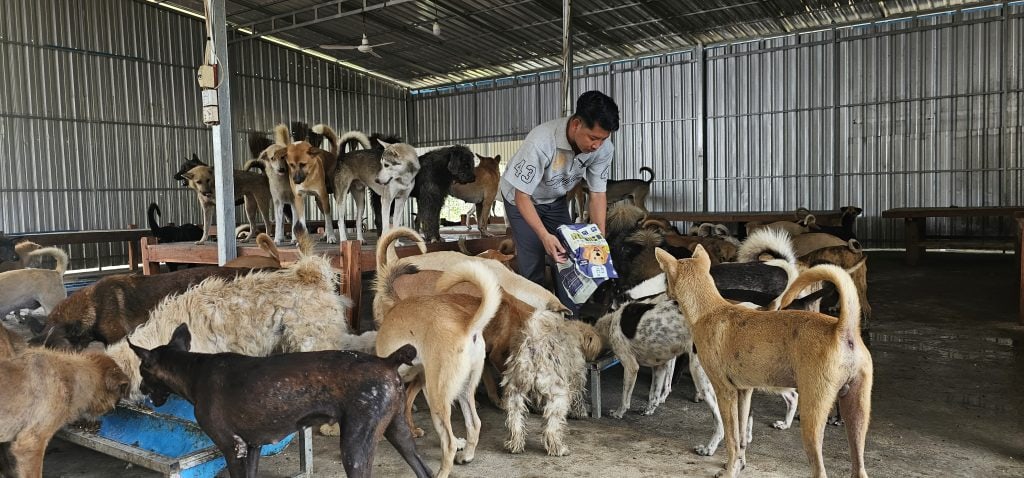
Dogs gather around Eung Seavleang as he prepares to feed them breakfast at The Smiles of Stray Animals, a dog rescue center, in Kampot province, on August 22, 2026. Photo by Hun Soprochea
By Hun Soprochea and Sre Lyhour
KAMPOT — Standing over a steaming giant wok pan, Eung Seavleang carefully stirs the soup before making his way through the shelter. The dogs rush toward a row of feeding bowls. Some leap excitedly, others wag their tails impatiently, while a few injured dogs move more slowly, waiting for breakfast with quiet determination.
For Seavleang, this has been his daily routine for nearly a decade.
Hidden among rice fields and mountains in Kampot province, ‘The Smiles of Stray Animals’ has become a refuge for Cambodia’s abandoned, injured and abused dogs. More than 200 dogs now call the shelter home, including over 100 rescued from its former location in Kampong Chhnang after financial setbacks and community complaints forced the operation to relocate.
Behind the shelter is one man’s determination to give unwanted dogs a second chance.

Photo by Sre Lyhour
For nearly 10 years, Seavleang has devoted much of his life—and much of his income—to rescuing stray dogs that many people ignore. His love for dogs began long before the shelter existed. When he rented a room closer to work in Phnom Penh, a handful of dogs came to live with him. Soon, his daily commute exposed him to injured and abandoned dogs lying along roadsides. Unable to ignore their suffering, he began rescuing them with his own salary. Veterinary treatment often exceeded US$200 for a single animal. When money ran short, he borrowed from his brother to cover the bills.
“Some people told me I was crazy,” Seavleang said. “Why rescue stray dogs? Why spend your money on them?”
The criticism never changed his mind.
As more dogs recovered, his rented room became overcrowded. He leased additional space, but landlords eventually refused to renew the agreements.
“They said they rent out rooms to humans only—not to dogs,” he said with a smile.
What began as one man’s determination gradually evolved into a full-time mission.
In 2017, Seavleang committed himself to rescuing stray dogs full time. At the time, social media had not yet become a reliable fundraising platform, leaving him to shoulder almost every expense—from food and transport to veterinary treatment.
As the number of rescued dogs continued to grow, he realized they needed a permanent home.
In 2020, he established ‘The Smiles of Stray Animals’ in Kampong Chhnang province. The shelter quickly became a sanctuary for abandoned, injured and abused dogs from across Cambodia, while donations from animal lovers slowly eased some of the financial burden.
The relief, however, proved short-lived.
Residents complained about the constant barking, prompting repeated reports to local authorities. At the same time, Seavleang discovered that the land he had been purchasing through installments had already been mortgaged by its owner. When the owner defaulted on the loan, the bank reclaimed the property, leaving the shelter without a future.
“The bank gave me only three months to leave,” Seavleang said. “Every night I wondered where I could take the dogs.”
He had only about US$8,000 in savings, but the land he found in Kampot cost nearly US$20,000. After pawning his car and exhausting every other option, he made an emotional appeal on social media.
The response exceeded his expectations.
Within four days, supporters from across Cambodia donated nearly US$10,000—enough to purchase land in Kampot and save the shelter from closure.
More than 100 rescued dogs had to be transported over seven trips to their new home in Kampot. The effort was exhausting, but the change was immediate.
“When we came here,” Seavleang said, “the dogs became happier. They play more, they’re less stressed and they don’t get sick as often.”
Seavleang is assisted by a small team that includes his two younger brothers and a sister. Together they feed the dogs, clean the compound and respond to calls from members of the public reporting injured or abandoned animals. Some rescue missions take only a few hours; others last days as frightened dogs hide or flee from strangers.
“When we go to rescue stray dogs, it’s usually just my two brothers and me,” said Mr. Ya, a caretaker. “Sometimes it takes one or two days to find them and bring them back. Some dogs are frightened and bite us, but we’ve learned how to rescue them safely.”
Every rescue brings new costs.

Photo by Sre Lyhour
Financial constraints have forced the shelter to reduce feeding from three meals a day to two. The dogs receive dry food in the morning and porridge with vegetables and meat in the evening. Veterinary treatment, vaccinations, medicine, electricity, water and shelter maintenance all depend largely on donations.
“Some days I owe money because I don’t have enough to pay for food and vaccinations,” Seavleang said. “I also have to think about water, electricity and helping support my younger siblings’ education.”
To maintain public trust, Seavleang regularly documents rescues, medical treatments and daily life at the shelter on Facebook, allowing supporters to see how their donations are used.
Even so, not everyone understands the realities of operating the shelter.
“Some people see that I have a car, land or decent clothes and immediately say I’m taking money from donations,” he said. “They don’t see that I work extra jobs to support my family and pay for the shelter.”
Undeterred by criticism, Seavleang continues sharing his daily operation online, believing transparency speaks louder than accusations.
For him, the greatest reward is watching frightened animals slowly learn to trust again. He said the memories of seeing dog meat on sale only fuels his determination – with hope that Cambodia will strengthen measures against dog meat trade and encourage greater compassion toward stray animals.
“As long as people continue supporting us, I will continue rescuing stray dogs for the rest of my life,” he said.
__________________
Note on AI use: This feature was reported and written by Hun Soprochea and Sre Lyhour, students in the ‘News Reporting and Writing II’ course, and edited by lecturer Ker Munthit. Gemini, free version, was used at the final editing stage to assist with language, grammar, structure and readability. AI was not used to generate reporting, facts, quotes or analysis. The edited text was fact-checked by the lecturer and approved by the authors before publication.