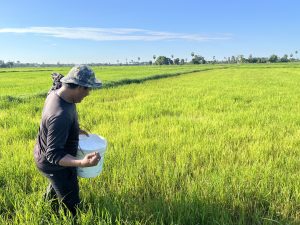
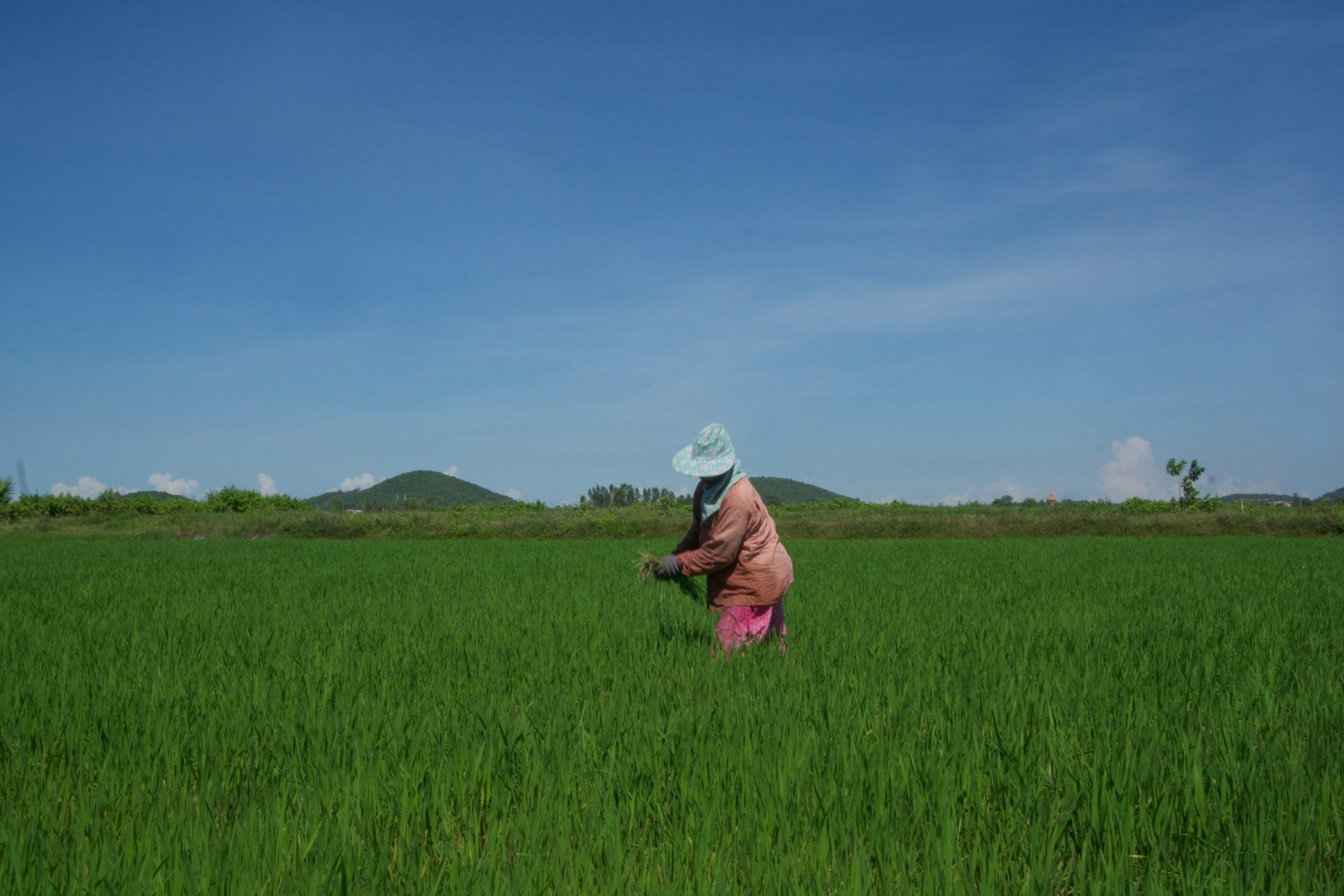
Ms. Sok Kea is removing weeds from her paddy field in Kiri Vong district, Takeo province, on June 22, 2026.
Photo by Kong Sophy.
By Kong Sophy and Sean Suzan
Takeo — A vast expanse of lush green rice fields stretches as far as the eye can see, framed by small, looming mountains divided by narrow red-dirt roads. Up close, farmers toil under the open sky while the steady hum of water pumps echoes across the paddies.
But beneath the scenic landscape lies a quiet crisis. Among the rhythmic sounds of heavy machinery, the farmers’ conversations carry a heavy, unified worry.
With the rainy season in full swing, 40-year-old Sok Kea is tending her land in Kiri Vong district, Takeo province, as she does every year. But this season, she made a difficult calculation: she is leaving half of her field uncultivated.
“I reduced the size of my field by half because rice farming no longer brings enough profit,” Ms. Kea explains, gazing over her parcel. “The selling price is completely uncertain—farmers only find out what they will earn after the harvest is already done. Now, I’m growing just enough to feed my family.”
Across rural Cambodia, farmers are facing the same brutal choice. Global trade shocks and rising fuel prices have sent the cost of plowing, irrigation, and fertilizer skyrocketing. Trapped between surging expenses and unpredictable crop prices, the country’s smallholders are watching their livelihoods evaporate.
The Compounding Cost of Cultivation
For smallholders, every step of the planting season now carries an inescapable financial burden.
A 50-kilogram bag of fertilizer that once cost 105,000 riels (US$25.60) has jumped to 160,000 riels (US$39). Hiring a plowing tractor has more than doubled from 112,500 riels to 262,500 riels (US$64) per hectare. Pesticide spraying costs have surged at a similar rate, said Ms. Kea.
In total, Ms. Kea now spends upwards of US$500 per hectare just to cultivate a field that yields roughly two to three tons of paddy.
Even those with their own machinery are struggling to stay afloat.
“I own a tractor, which cuts my costs nearly in half compared to those who rent,” said Heng Soriya, who owns 6 hectares of rice field. “Even so, I am still losing money because farming expenses are very high. Farmers who have to rent all the equipment and services are facing even bigger problems.”
For many, abandoning the land isn’t an option.
“If we stop farming, the only options are construction work or factory jobs,” said Chan Chamroeun, 42, a lifelong farmer in Prey Romdeng commune. “At my age, no factory wants to hire me. In construction, I have no experience—maybe I could mix cement, but how much would I earn a month?”
“By the time I’m ready to harvest, my debts have already accumulated,” Mr. Chamroeun added. “The price I receive for the paddy is rarely enough to pay them back.”

A farmer works in the rice fields as the planting season begins, Takeo province, on June 22, 2026.
Photo by Kong Sophy.
Squeezed from Both Ends
The problem isn’t just rising input expenses—it is the crippling drop in market prices at harvest time.
Mr. Som Kea, a high school biology teacher who long supplemented his salary by cultivating a 10-hectare plot, made the unprecedented decision to skip planting entirely this year.
“Rice farming is no longer profitable due to the rising prices of fuel, fertilizers, seeds, and machinery rental,” Mr. Kea said plainly. He added that what makes it so discouraging is that even a bumper harvest offers no escape, because market prices for rice continue to drop.
According to Mr. Kea, traders are currently offering around 750 to 800 riels (US$0.18–$0.19) per kilogram. To break even and earn a living, farmers need at least 1,000 to 1,300 riels (US$0.24–$0.32) per kilogram.
Cambodia Rice Federation reports from mid-June 2026 show wet OM paddy prices in neighboring Angkor Borei district floating at a dismal 850 to 870 riels per kilogram.
This squeeze forces smallholders straight into micro-finance debt traps.
“When rice income falls short, farmers can only afford to pay the interest on their loans, leaving the principal untouched to keep growing,” Mr. Kea explained.
Mr. Chamroeun, the farmer in Prey Romdeng commune, echoes the sentiment grimly: “If rice prices rise, we may be able survive. If they don’t, we will face even more debts. In the end, there is nothing left for a farmer except debt owed to traders and private banks.”
The stark reality on the ground contrasts sharply with Cambodia’s soaring national trade figures. In 2025, the country exported more than 940,000 tons of milled rice and 6.8 million tons of paddy, generating nearly US$2.2 billion in revenue, according to the state news agency AKP.
That momentum carried into 2026. By June, Cambodia had already exported some 630,000 tons of rice – a figure that almost matches the 646,000 tons exported in 2024, according to the Cambodia Rice Federation.
Yet, this macroeconomic success relies on heavy national imports of chemical inputs. In 2025, the country spent approximately US$636 million on fertilizer and pesticide imports, including around US$419 million on chemical fertilizers alone, according to Cambodia Investment Review. As global energy prices spike, the burden of these imported costs is pushed directly onto rural growers who have zero bargaining power over the selling price of their grain. The rich trade balance grows, while rural communities absorb all the financial risk. As Ms. Sok Kea puts it simply: “The poor are getting poorer, and the rich are getting richer.”
Bound to the Soil
Back in Kirivong, Heng Soriya said she has no alternative to working her field despite the looming financial risk.
“I will keep farming because it is my job,” Ms. Soriya said quietly. “I don’t have the skills for a factory job, and my children are still young—I need to stay home to take care of them. Even if I lose money on the market, at least I can keep the rice to feed my family.”
_________
Note on AI use: This feature was reported and written by Kong Sophy and Sean Suzan, students in the ‘News Reporting and Writing II’ course, and edited by lecturer Ker Munthit. ChatGPT, free version, was used at the final editing stage to assist with language, grammar, structure and readability. AI was not used to generate reporting, facts, quotes or analysis. The edited text was fact-checked by the lecturer and approved by the authors before publication.