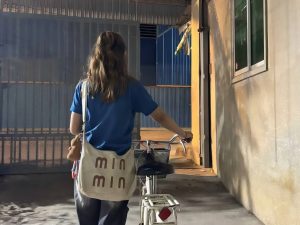
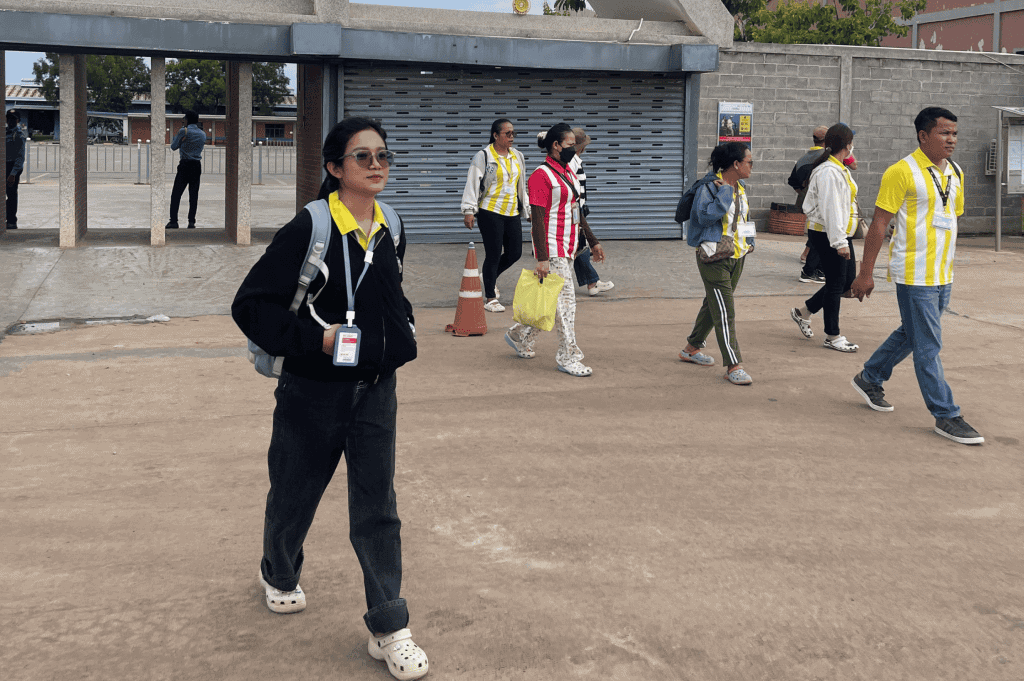
Teth Koteyjeas, 31, walks out of a factory in Kampong Chhnang province on July 13, 2026. She works at the factory from Monday to Friday. On Saturday, the mother of two children attends classes at a university in Phnom Penh, studying for a degree in accounting to build a better future for herself and her family.
Photo by Hou Sokkeang
By Oeurn Sokleap and Hou Sokkeang
PHNOM PENH — From Monday to Friday, as soon as the sun breaks over the horizon, Teth Koteyjeas joins the stream of factory workers heading to their shifts in Kampong Chhnang province, facing long, grueling hours of manual labor to earn a basic wage.
Come Saturday morning, however, the 31-year-old mother of two rides her motorbike to attend classes at VANDA University in Phnom Penh – some 55 kilometers from her home in Chann Keak village, Orussey commune, Kampong Tralach district. In class, she works toward her degree in accounting alongside classmates who are mostly 19-year-olds fresh out of high school.
Koteyjeas represents a silent rebellion against the script written for rural, minority women in Cambodia. Growing up as a member of the Cham Muslim minority in Chann Keak village, she learned early that survival took priority over schooling. When her father died, she was just ten years old. Her mother was left alone to raise four children on a frail income.
The financial pressure eventually caught up with Koteyjeas in 2012. At 17 years old and in the 11th grade, the burden on her family proved insurmountable. Like countless young women in impoverished rural communities, she made the decision to drop out and marry.
“I believed that my dream of finishing high school to get a certificate in grade 12 was already over,” Koteyjeas recalled.
Marriage brought quick obligations. By her late twenties, Koteyjeas was managing a home, raising two children, and taking a job in a local factory to help cover daily survival. In her village, traditional ideas about a woman’s role remained deeply rooted.
“Women don’t need to study further—staying home, cooking, caring for her husband and children should be enough,” her mother, Sa Teymas, often told her.
Her husband, Sun Pov, initially worried about her leaving home to study and work far away, preferring that she stay close to care for their children. However, Koteyjeas refused to accept that her story was fully written. She watched her mother exhaust herself doing manual labor for a lifetime, barely surviving, and swore she would find a path to something more.

Teth Koteyjeas, 31, prepares to drive her motorbike to go home after finishing her shift at a factory in Kampong Chhnang province on July 13, 2026.
Photo by Hou Sokkeang
The Turning Point
For nearly ten years, Koteyjeas didn’t have the guidance she needed to imagine a way back to school. That began to change when a friend introduced her to Women Peace Makers (WPM), a non-governmental organization focused on female empowerment, gender equality, and conflict transformation in rural Cambodian communities.
Koteyjeas joined as a volunteer, participating in leadership workshops and “gender cafés”— open discussion spaces where local youth spoke candidly about education, domestic roles, and women’s rights.
“WPM empowered me to believe in myself again,” she said.
In 2022, ten years after dropping out of Grade 11, Koteyjeas did something those around her considered impossible: she registered for the national Grade 12 exam as a self-study candidate.
Without formal classes, teachers, or study groups, she bought second-hand textbooks and studied alone at night after her factory shifts and domestic chores were finished. In 2023, she walked into the examination hall alongside teenagers half her age—and passed.
With her high school diploma in hand, Koteyjeas immediately applied to VANDA University in Phnom Penh to pursue a degree in accounting. Her husband, seeing her determination, stepped up to help care for their children and manage the household on weekends while she attended classes.
Bridging Two Worlds
The transition to university life meant navigating an obvious generation gap. When her classmates first met her, many assumed she was a visitor.
“When I first heard her age, I was shocked,” says Li Sovan, a fellow freshman. “I didn’t believe it at first, and I wondered why someone older would come back to study.”
Sovan recalled the moment she noticed Koteyjeas wearing a wedding ring on her finger. “I asked her about it, and when she said she was married with children, I asked, ‘Are you lying to me?’ But it was real. I admire her so much because she never let her age stop her.”
Another classmate, Khun Aliza, was struck by how effortlessly Koteyjeas blended into the group despite her double life.
“Her face looks younger than her age, but she is the most active person in our classroom,” Aliza said. “She creates our group chats, drops lesson notes for everyone, and asks the teachers questions whenever something isn’t clear. She explains assignments to anyone who doesn’t understand. We gain a lot from her kindness.”
For Koteyjeas, being surrounded by teenagers isn’t a source of embarrassment; it is a second chance.
“I see it as an opportunity to experience the youth I missed when I was their age,” she said. “Through them, I learn not only in the classroom, but also how they think, communicate, and solve problems.”

Teth Koteyjeas, 31, rests on a bed outside her house after finishing her shift at a factory in Kampong Chhnang province on July 13, 2026.
Photo by Hou Sokkeang
Beyond the Degree
Koteyjeas’ weekend commute from Kampong Chhnang to Phnom Penh is long and consumes a significant portion of her factory earnings. Yet she views the weekly expense not as a financial loss, but as an investment in a broader mission.
She deliberately chose accounting over other majors because of what she witnessed growing up in her home district.
“Growing up poor, I saw how many families in my village—especially women—had no idea how to manage money or plan for the future,” Koteyjeas explains. In rural Cambodian communities, poor financial literacy frequently leaves households vulnerable to cycle of predatory debt and economic instability.
Her goal is not simply to secure an office job in the capital. Once she earns her degree, Koteyjeas plans to return to her village to launch financial literacy workshops tailored specifically for rural women, teaching them how to save, budget, and gain economic independence.
“I want every girl who thinks it is too late to know that it’s not,” she said. “It is never too late to start doing what you really want.”

Teth Koteyjeas, 31, sits in a classroom at VANDA University in Phnom Penh on August 8, 2026. Every Saturday, the factory worker and mother of two children attends classes at the university, studying for a degree in accounting to build a better future for herself and her family.
Photo by Hou Sokkeang

Teth Koteyjeas, 31, discusses an assignment with her classmates – who are mostly fresh high school graduates – at VANDA University in Phnom Penh on August 8, 2026. Every Saturday, the factory worker and mother of two children attends classes at the university, studying for a degree in accounting to build a better future for herself and her family.
Photo by Hou Sokkeang
____________________
Note on AI use: This feature was reported and written by Oeurn Sokleap and Hou Sokkeang, students in the ‘News Reporting and Writing II’ course, and edited by lecturer Ker Munthit. Gemini, free version, was used at the final editing stage to assist with language, grammar, structure and readability. AI was not used to generate reporting, facts, quotes or analysis. The edited text was fact-checked by the lecturer and approved by the authors before publication.