
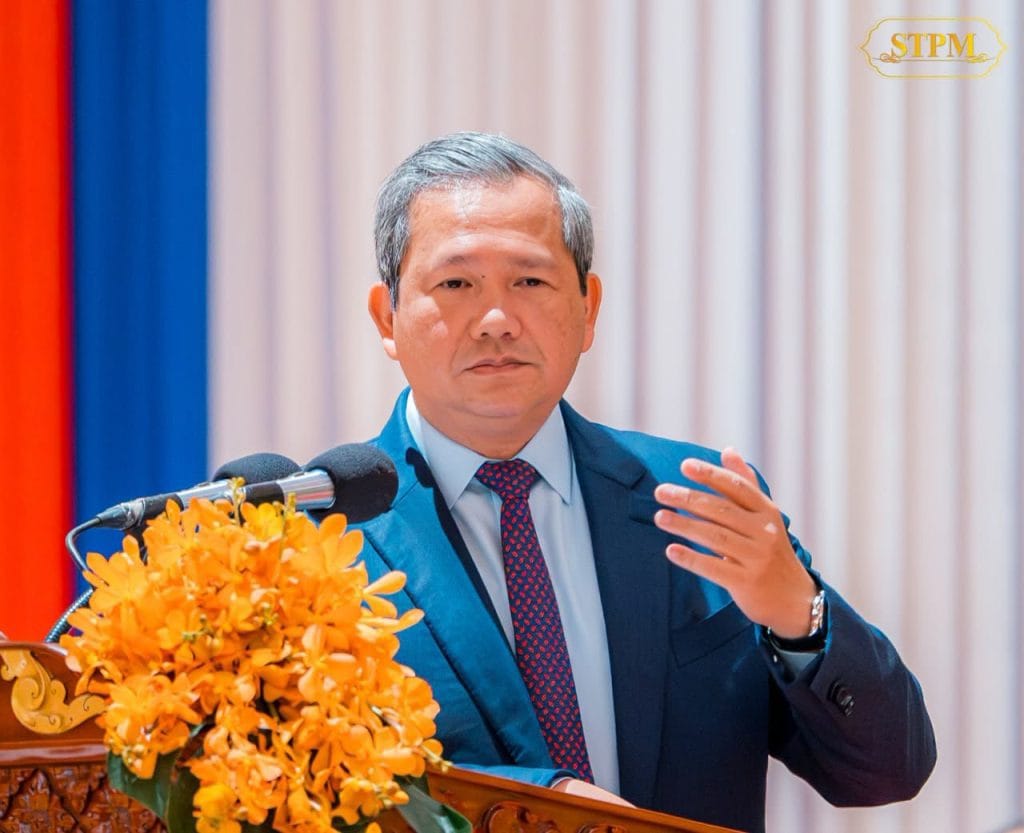
Photo Credit: Facebook Page of Samdech Thipadei Hun Manet, Prime Minister of Cambodia
By Nan Meng Hor
Phnom Penh — Prime Minister Hun Manet has urged Cambodian education sector to strengthen education quality and academic integrity as artificial intelligence (AI) becomes widely available for learning, warning that the technology should support — not replace — students’ ability to develop genuine knowledge and skills.
Speaking at a graduation ceremony at the Royal University of Laws and Economics on August 6, the prime minister stressed that universities must ensure technology enhances education without encouraging students to depend heavily on AI for learning and obtaining a degree.
“If we provide technology to students without setting boundaries — defining what level they must do the tasks by themselves versus what level they are allowed to use technology — we will run into serious issues,” he said.
He said Cambodia needs graduates who can genuinely perform their jobs, rather than simply access information through smartphones and other technologies. While AI can provide instant answers, employers still need workers with practical skills and the ability to apply what they know.
“Absolutely do not let technology replace your own thinking. That means you [students] shouldn’t rely too heavily on technology while possessing nothing within yourself, hoping that technology alone will make you successful in life,” Prime Minister Hun Manet said.
He also encouraged students to focus on mastering one or two core skills that they can apply, develop and research further, rather than trying to master too many subjects superficially.
“What matters most [for youth] is knowing how to pay attention and putting your heart into learning,” the prime minister said. “Never let your phone do the work in your place.”
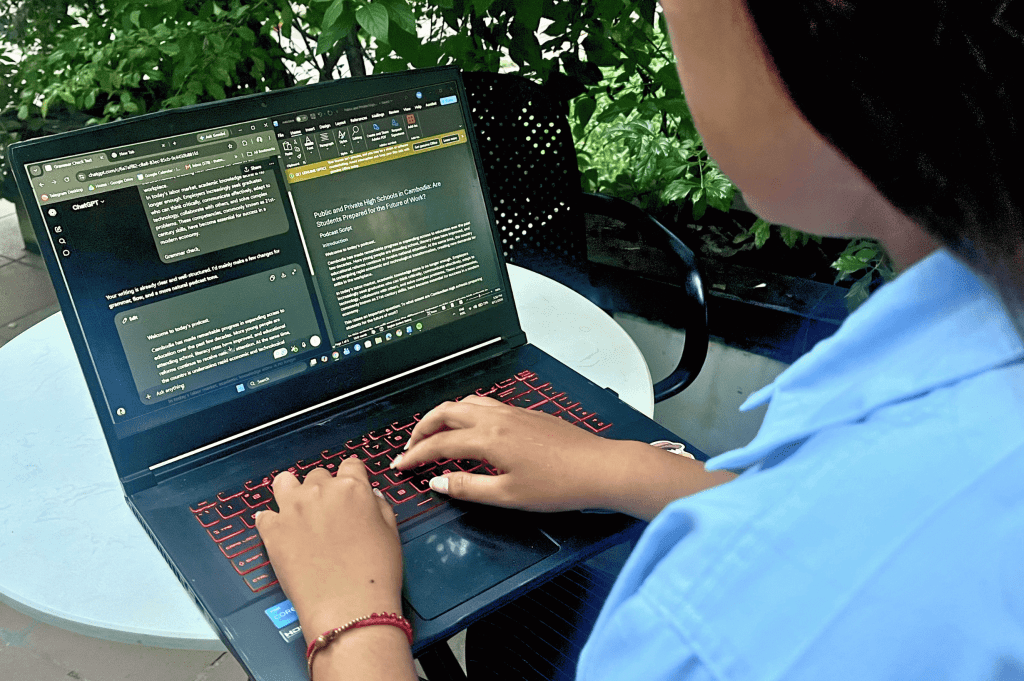
Student using AI (ChatGPT) to fix their homework.
Photo by Nan Meng Hor
Ung Bun Y, head of the Department of Media and Communication at the Royal University of Phnom Penh, said the prime minister’s warning was particularly relevant as AI continues to advance rapidly. He cautioned that AI-generated information may not always be accurate or truthful and could, in some cases, raise concerns over individual or institutional privacy.
Banning AI altogether is neither practical nor desirable, Bun Y said, adding that education institutions should establish clear boundaries to prevent its misuse. He added that guidelines on AI usage are being drawn up for lecturers and students to apply across disciplines at DMC. The guidelines are expected to be rolled out in early 2027.
“We want to ensure that our students, lecturers, and staff can use AI to support learning, teaching, research, and creative work safely, ethically, and responsibly,” he said.
AI Acknowledgment: AI was used to transcribe the speech, while the overall content was written and edited without using AI.